


Hearing yourself speak helps fine-tune tongue movements


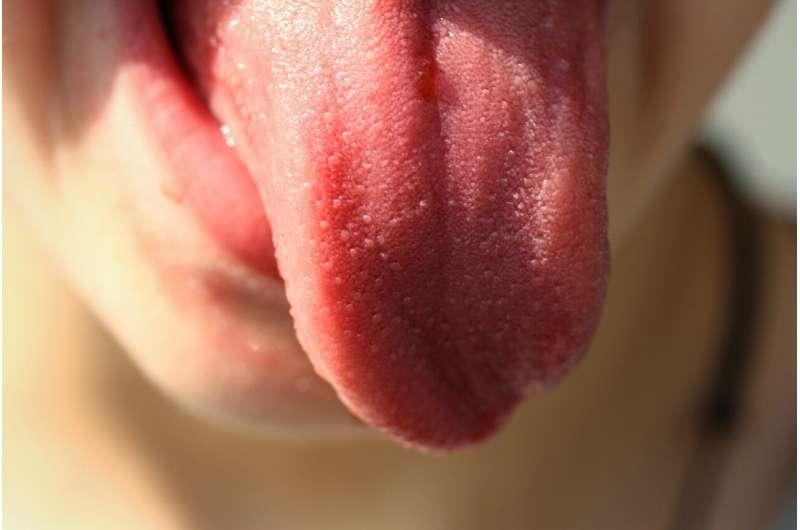
When people cannot hear their own voices, their tongue movements become less precise when they speak, according to a study from the University of Oklahoma. This finding, the first direct evidence of its kind, could help guide therapies designed to restore speech control in people with hearing loss or those whose tongues have been affected by cancer.
The study, led by Matthew Masapollo, Ph.D., an assistant professor at the OU College of Allied Health, was published in the Journal of Speech, Language, and Hearing Research. It answers a longstanding question in neuroscience: How much do we rely on hearing to produce speech?
“Speech feels automatic, but it’s one of the most complex motor skills that we routinely perform. A typical adult produces up to 16,000 words each day—that’s tens of thousands of precisely timed movements requiring precise coordination throughout the vocal tract,” Masapollo said. “What we’ve shown in this study is that auditory information helps regulate the control of the movements.”
In the study, participants spoke both when they could hear their own voice and when their hearing was masked. Small sensors attached to the tongue and jaw tracked their movements using a technology called electromagnetic articulography as participants produced the sounds “ta” and “da.”
The findings were strikingly selective. When hearing was masked, tongue-elevating movements—those that press the tongue against the roof of the mouth to produce speech sounds—became less precise and more variable. Jaw motion was unaffected.
“The effect was strongest during tongue-elevating movements, rather than overall tongue motion,” Masapollo said. “This suggests the brain doesn’t fully pre-plan speech movements; it also relies on real-time sensory information to regulate tongue movements for speech.”
Compared to the jaw, which essentially rotates up and down, the tongue is very malleable—consider how the tongue can dislodge a piece of food stuck in the mouth, Masapollo said. The study suggests that flexible structures like the tongue require more sensory input in order to regulate their control for speech production.
The study is relevant to people with hearing loss, such as those who have cochlear implants. The research is also informing Masapollo’s new study involving patients treated for tongue cancer at OU Health Stephenson Cancer Center. Cancer treatment can be detrimental to speech for various reasons. Chemotherapy may damage hearing, surgery may remove part of the tongue, and radiation can reduce the tongue’s flexibility.
“The sensory nerves of the tongue are often damaged during surgery, and radiation creates a lot of fibrous tissue in the tongue,” he said. “People who have part of their tongue removed may also have trouble swallowing. When we swallow, the tongue rises to press against the roof of the mouth, forming a tight seal—similar to the tongue movements used to produce the sounds ‘ta’ or ‘da.’ This seal helps guide and control the movement of food and liquid during swallowing, just as precise tongue positioning is critical for producing speech.”
Masapollo said he will first see study participants prior to treatment, then after surgery and/or radiation and continuing for three years. He seeks to understand the trajectory of their motor impairment and how radiation and surgery to different parts of the tongue affect its control. Ultimately, his research could assist speech pathologists and occupational therapists in better helping their patients with speech rehabilitation.
Masapollo’s research is unique among speech motor control studies. The electromagnetic articulography system makes his sophisticated analysis possible.
“Previous studies have relied almost exclusively on subjective perceptual ratings of speech,” he said. “This is the first direct evidence that auditory input specifically affects the speech-related motion of the tongue. You wouldn’t be able to infer that from just listening to someone or even doing an acoustic analysis of speech. You have to directly observe the movements hidden within the inner reaches of the vocal tract, which we are now able to do.”
More information
Matthew Masapollo et al, Precision of Tongue Control for Task-Relevant Articulatory Goals Diminishes Without Real-Time Auditory Feedback, Journal of Speech, Language, and Hearing Research (2026). DOI: 10.1044/2025_jslhr-25-00514
Key medical concepts
Clinical categories
Hearing yourself speak helps fine-tune tongue movements (2026, March 18)
retrieved 18 March 2026
from https://medicalxpress.com/news/2026-03-fine-tune-tongue-movements.html
part may be reproduced without the written permission. The content is provided for information purposes only.
📰 This article was curated and published by
HEALTH GUIDANCE HUB
— your trusted source for the latest health news, medical research, and wellness guidance.
Visit us at https://healthguidancehub.space/ for more health insights.
