


First ever atomic movie reveals hidden driver of radiation damage
- Date:
- March 24, 2026
- Source:
- Fritz Haber Institute of the Max Planck Society
- Summary:
- Researchers have visualized atoms in motion just before a radiation-driven decay process occurs, revealing a surprisingly dynamic scene. Instead of remaining fixed, the atoms roam and rearrange, directly influencing how and when the decay unfolds. This âatomic movieâ shows that structure and motion play a central role in radiation damage mechanisms. The findings could improve our understanding of how harmful radiation affects biological matter.
- Share:
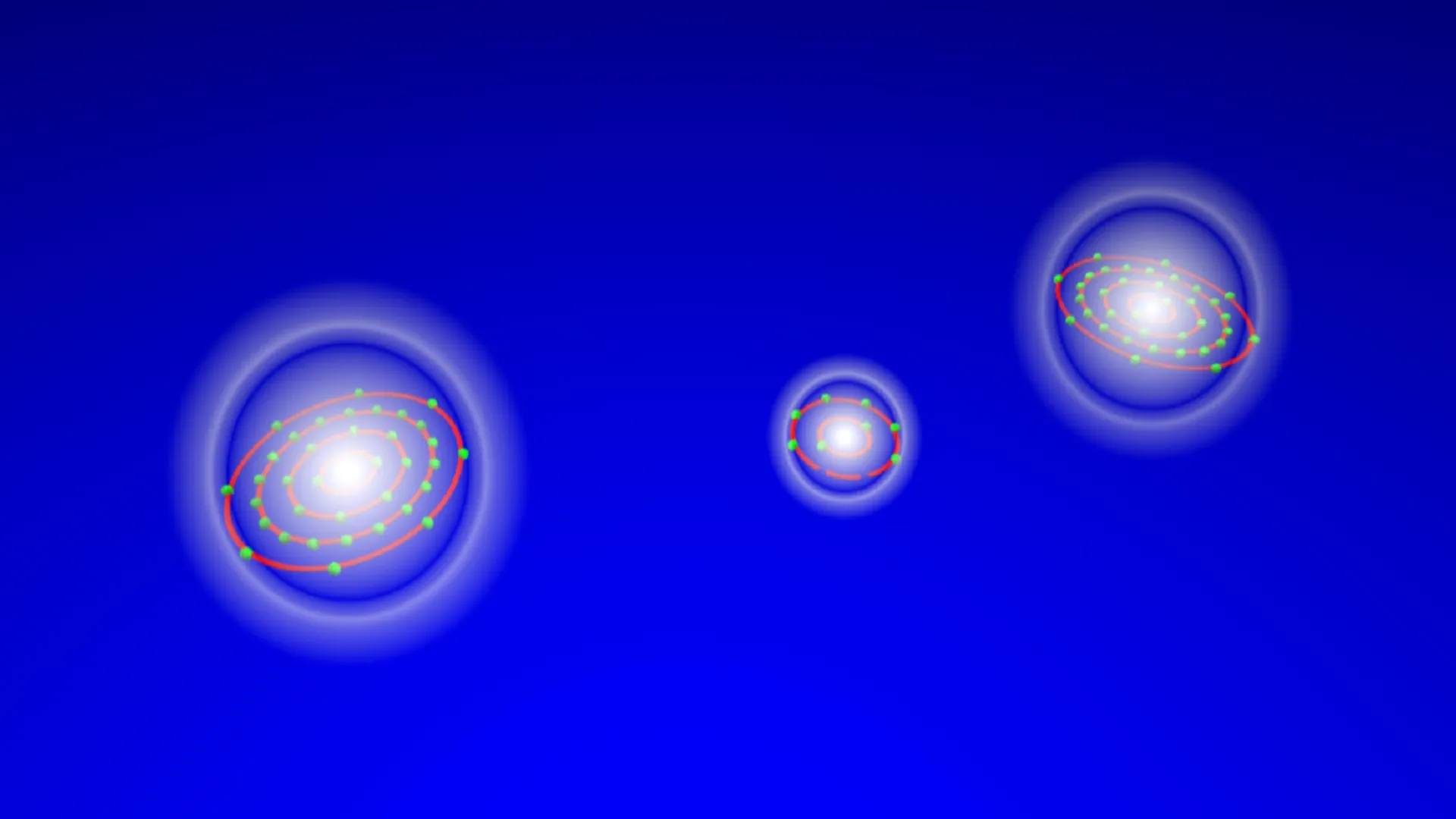
Scientists filmed atoms “roaming” before exploding — revealing a hidden driver of radiation damage.
- The process: The research centers on electron-transfer-mediated decay (ETMD), a radiation-driven process that can cause loosely bound atoms to break apart. This mechanism is especially important because it can generate highly reactive particles in water, making it a key factor in how radiation damages biological systems.
- The experiment: Scientists tracked this process in remarkable detail using a specialized reaction microscope, combined with advanced theoretical simulations. This allowed them to follow exactly how the decay unfolds over time in a carefully controlled model system.
- What they discovered: The team effectively created a real-time “movie” of atoms moving around each other for up to a picosecond before the system finally breaks apart. This reveals a dynamic and constantly changing process rather than a simple, static event.
- Why it matters: These findings provide a clearer picture of how radiation damage develops at the atomic level. By understanding this process more deeply, researchers can improve models of radiation effects in biological environments and potentially guide future protective strategies.
How Radiation Damages Cells at the Atomic Level
High-energy radiation, such as X-rays, can harm living cells by disturbing atoms and molecules. When this happens, those particles become excited and often break down, which can destroy important biomolecules and disrupt larger biological systems. Because many different types of decay processes can occur, scientists study them closely to better understand how radiation causes damage and how it might be reduced.
In a new study, researchers from the Molecular Physics Department and international collaborators focused on a specific radiation-driven process called electron-transfer-mediated decay (ETMD). In this process, radiation first excites an atom. That atom then stabilizes itself by pulling an electron from a nearby atom, while the released energy ionizes a third neighbor. The team was able to directly observe how atoms in a model system shift and reorganize before this unusual decay takes place. Their results provide the most detailed real-space and real-time view of ETMD so far.
Tracking Atomic Motion in Real Time
To investigate this process, the scientists used a simple model system made of one neon atom weakly bound to two krypton atoms (NeKr2 trimer). After knocking out an electron from the neon atom using soft X-rays, they followed how the system evolved for up to a picosecond, which is extremely long on an atomic timescale, before the decay occurred. During this time, an electron was transferred between atoms and a low-energy electron was emitted.
Using an advanced COLTRIMS reaction microscope at the synchrotron facilities BESSY II (Berlin) and PETRA III (Hamburg), the researchers reconstructed the exact arrangement of the atoms at the moment the decay happened. They paired these measurements with detailed ab initio simulations that tracked thousands of possible atomic pathways and calculated how likely decay was along each one.
A “Movie” of Atoms on the Move
The findings revealed something unexpected. The atoms did not stay fixed in place. Instead, they moved in a roaming-like pattern, constantly changing their positions and reshaping the structure of the system. This motion strongly affected both the timing and the outcome of the decay.
“We can literally watch how the atoms move before the decay happens,” says Florian Trinter, one of the lead authors. “The decay is not just an electronic process — it is steered by nuclear motion in a very direct and intuitive way.”
The study shows that ETMD does not occur from a single stable structure. Different arrangements dominate at different moments. Early on, decay happens near the original configuration. Later, one krypton atom moves closer to the neon atom while the other shifts farther away, creating favorable conditions for electron transfer and energy flow. At even later stages, the atoms form more stretched and distorted shapes, reflecting a swinging, roaming motion. These changes cause the decay rate to vary significantly depending on the geometry.
“The atoms explore large regions of configuration space before the decay finally takes place,” explains Till Jahnke, senior author of the study. “This shows that nuclear motion is not a minor correction — it fundamentally controls the efficiency of non-local electronic decay.”
Why Understanding ETMD Matters
ETMD has drawn growing interest because it produces low-energy electrons, which can trigger chemical damage in liquids and biological materials. Knowing how this process depends on atomic arrangement and motion is essential for accurately modeling radiation damage in water and in biological environments, as well as for interpreting ultrafast X-ray experiments. The results also support the development of theoretical models that can apply these insights to larger and more complex systems.
“This work shows how non-local electronic decay can be used as a powerful probe of molecular motion,” the authors conclude. “It opens the door to imaging ultrafast dynamics in weakly bound matter with unprecedented detail.”
Story Source:
Materials provided by Fritz Haber Institute of the Max Planck Society. Note: Content may be edited for style and length.
Journal Reference:
- Florian Trinter, Jaroslav Hofierka, Jonas Rist, Max Kircher, Miriam Weller, Niklas Melzer, Dimitrios Tsitsonis, Angelina Geyer, Jan Kruse, Gregor Kastirke, Joshua B. Williams, Tsveta Miteva, Reinhard Dörner, Markus S. Schöffler, Maksim Kunitski, Nicolas Sisourat, Lorenz S. Cederbaum, Till Jahnke. Tracking the Complex Dynamics of Electron-Transfer-Mediated Decay in Real Space and Time. Journal of the American Chemical Society, 2026; 148 (4): 4126 DOI: 10.1021/jacs.5c15510
Cite This Page:
📰 This article was curated and published by
HEALTH GUIDANCE HUB
— your trusted source for the latest health news, medical research, and wellness guidance.
Visit us at https://healthguidancehub.space/ for more health insights.
