

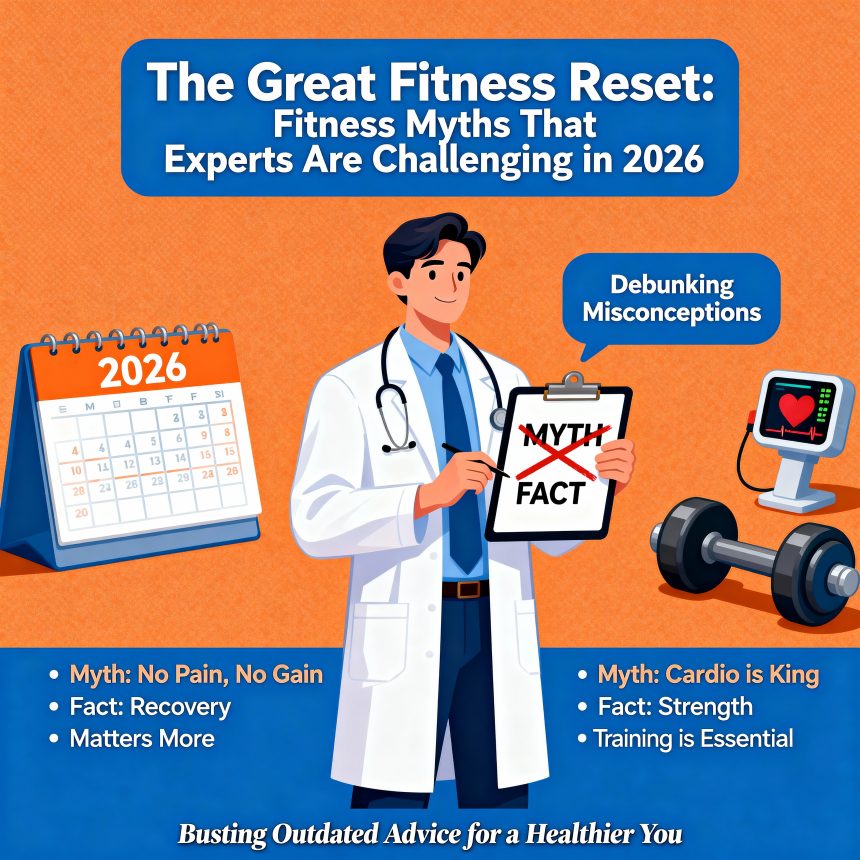
As we step into the first week of January 2026, the global wellness landscape has shifted from chasing aesthetic perfection to pursuing biological longevity. On this Monday, January 5, 2026, the conversation in elite performance circles is no longer about how much you can lift or how fast you can run, but how efficiently your body operates at a cellular level. The year 2026 marks a pivotal point where the “more is better” philosophy has been officially retired in favor of “bio-harmony.”
- Myth 1: The 10,000 Step Rule is the Universal Health Gold Standard
- Myth 2: Weight Loss Medications (GLP-1s) Mean You Can Skip the Gym
- Myth 3: The Finite Heartbeat Theory and the Danger of Cardio
- Myth 4: Cardio is the Best Way to Manage Weight
- Myth 5: Supplements Can Replace Whole Food Synergy
- Myth 6: The “No Pain, No Gain” Ethos is Necessary for Progress
- Myth 7: Wearables Provide 100 Percent Accurate Health Data
- Myth 8: You Are “Too Old” to Start Strength Training
- Myth 9: Spot Reduction of Fat is Possible
- Myth 10: High Protein Diets are Only for Bodybuilders
- The Path Forward: Personalized Bio-Harmony
For decades, the fitness industry was built on a foundation of generalized advice that often ignored individual biochemistry. However, with the integration of AI-driven diagnostics and real-time metabolic tracking, the myths that once governed our gym routines are being dismantled by scientists and top-tier coaches. If you are looking to optimize your healthspan this year, you must unlearn these outdated concepts.
Myth 1: The 10,000 Step Rule is the Universal Health Gold Standard
For years, the figure of 10,000 steps was heralded as the magical number for cardiovascular health and longevity. In 2026, experts are finally putting this marketing-derived myth to bed. Recent longitudinal studies, including those published in late 2025 by the University of Texas at Arlington, suggest that the “10,000” number was never a scientific benchmark but rather a clever piece of 1960s branding.
Research now indicates that for most adults, the curve of diminishing returns begins much earlier, often around 7,000 to 7,500 steps. More importantly, the focus has shifted from the quantity of steps to the intensity and distribution of movement. Experts are now advocating for “exercise snacking,” which involves short, vigorous bursts of activity spread throughout the day to combat the metabolic damage of sedentary behavior.
Dr. Yue Liao, a leading researcher in physical activity sensors, notes that adding just 30 minutes of light activity can meaningfully improve mental health and reduce chronic disease risk. In 2026, we are learning that a person taking 6,000 steps with intentional intensity and metabolic breaks may actually be healthier than someone hitting 12,000 steps at a sluggish, distracted pace.
Source: Mirage News: Dr. Liao’s Tips For Healthier Habits In 2026
Myth 2: Weight Loss Medications (GLP-1s) Mean You Can Skip the Gym
The rise of GLP-1 receptor agonists has revolutionized weight management, but it has also birthed a dangerous myth: that these “miracle” medications are a replacement for physical exertion. By January 2026, clinical data from the previous year has highlighted a “hidden cost” to rapid weight loss via medication alone: significant muscle loss.
Current clinical research shows that up to 39 percent of weight lost through GLP-1 usage can be lean body mass, rather than fat. This is a red flag for longevity experts because muscle is a primary metabolic organ. Losing muscle at this rate accelerates a condition known as sarcopenia, which was previously seen mainly in the elderly.
The 2026 consensus is clear: medication without movement is a recipe for long-term metabolic failure. Experts now prescribe “Resistance-First Weight Loss” protocols, where strength training is mandatory for anyone on metabolic medications. The goal is to preserve mitochondrial function and resting metabolic rate. If you lose the weight but lose your muscle, your metabolic “engine” becomes smaller, making weight regain almost inevitable once the medication is paused.
Source: Sword Health: GLP-1 Muscle Loss and the Hidden Cost
Myth 3: The Finite Heartbeat Theory and the Danger of Cardio
A persistent and scientifically inaccurate myth that resurfaced in the early 2020s suggested that the human heart has a finite number of beats, and that exercising “uses them up” faster, leading to an earlier death. In 2026, breakthroughs in cardiovascular efficiency research have completely shattered this notion.
Groundbreaking studies from the Victor Chang Cardiac Research Institute, published in JACC: Advances, demonstrate that while the heart beats faster during exercise, the overall effect of being fit is a massive “saving” of heartbeats over a 24-hour period. Fitter individuals have significantly lower resting heart rates, often saving over 11,000 beats per day compared to sedentary individuals.
In 2026, your “metabolic efficiency score” is the metric that matters. Even an hour of intense cardiovascular training only adds a few thousand beats to your daily total, while the subsequent 23 hours of a lower resting heart rate provide a net gain in cardiac longevity. Exercise does not drain your “battery,” it upgrades it to a high-capacity system that operates with far less strain.
Source: ScienceDaily: Scientists Shatter Major Exercise Myth
Myth 4: Cardio is the Best Way to Manage Weight
The “treadmill till you drop” era is officially over. In 2026, fitness experts are challenging the idea that cardio is the most effective tool for weight management. While cardiovascular health is essential for heart and lung function, it is not the primary driver of a healthy body composition for most people.
Strength training has taken the lead as the foundation of weight management. The reason lies in the resting metabolic rate (RMR). Muscle tissue is much more metabolically active than fat tissue. By building lean muscle, you increase the number of calories your body burns while you are sleeping or sitting at your desk.
Experts in 2026 are advocating for a “Hybrid Training” model. This approach combines heavy resistance training to build the metabolic engine with Zone 2 cardio (low-intensity, steady-state) to optimize mitochondrial health. The myth that you need to “sweat it out” on a bike for hours to lose fat has been replaced by the science of muscle preservation and metabolic flexibility.
Source: Massachusetts General Hospital: Fitness Myths Fact vs Fiction
Myth 5: Supplements Can Replace Whole Food Synergy
The $200 billion supplement industry has long pushed the idea that a pill or powder can provide the same benefits as whole foods. In 2026, the myth of “isolated nutrients” is being challenged by the concept of “Bio-Harmony Nutrition.”
Researchers are finding that the “food matrix” (the complex structure of nutrients, fiber, and phytochemicals in whole foods) interacts with our gut microbiome in ways that synthetic supplements cannot replicate. While personalized supplement protocols based on bloodwork are trending in 2026, they are being viewed as “gap-fillers” rather than foundational pillars.
The focus this year is on “Microbiome Personalization.” Instead of general multivitamins, experts are recommending mineral-rich produce, fermented foods, and sea vegetables like chayote to support the gut-brain axis. The myth that you can “hack” a poor diet with high-end supplements has been debunked by the reality that our bodies require the synergistic complexity of real food to truly thrive.
Source: Dr. Axe: Wellness Trends 2026
Myth 6: The “No Pain, No Gain” Ethos is Necessary for Progress
The aggressive, “grind-culture” mentality of previous decades is being replaced by the “JOMO” (Joy of Missing Out) movement in fitness. In 2026, experts are warning against the “No Pain, No Gain” myth, noting that chronic soreness is often a sign of poor recovery and systemic inflammation rather than progress.
The rise of nervous system regulation as a fitness metric has changed how we view effort. We now understand that training in a state of high cortisol and chronic stress actually inhibits muscle growth and fat loss. Modern fitness programs in 2026 prioritize “Zone Zero” movements (ultra-low-intensity movement) and restorative practices like somatic breathwork and magnesium bathing.
High-end health clubs are now removing some of their traditional weight equipment to make room for “recovery sanctuaries.” The goal is to move from a state of “survival” training to “resilience” training. If your workout is leaving you depleted for days, experts in 2026 would argue that you aren’t working hard, you’re working inefficiently.
Source: Les Mills: 7 Key Trends Shaping Fitness in 2026
Myth 7: Wearables Provide 100 Percent Accurate Health Data
While wearable technology is the number one fitness trend of 2026, experts are cautioning against the myth that these devices are infallible. As smart rings and continuous glucose monitors (CGMs) become mainstream, a new phenomenon called “data anxiety” has emerged.
The myth is that every data point on your watch is a direct reflection of your health. However, many consumer-grade sensors still have significant margins of error, especially regarding sleep stages and caloric expenditure. In 2026, the most advanced coaches are teaching “Intuitive Data Integration.” This involves using wearables as a guide while still listening to the body’s internal cues.
Furthermore, we are seeing a shift toward “Digital Twins,” where AI uses your wearable data to simulate long-term health outcomes. While this is powerful, experts remind us that the most important metric is how you feel, move, and recover, not just the “score” an algorithm gives you each morning.
Source: ACSM: Top Fitness Trends for 2026
Myth 8: You Are “Too Old” to Start Strength Training
One of the most damaging myths still lingering in some circles is that strength training is only for the young and that older adults should stick to “gentle” movements like walking. In 2026, geriatric exercise science has completely inverted this advice.
“Active aging” programs now emphasize heavy resistance training for those in their 70s and 80s. This is because sarcopenia and bone density loss are the primary drivers of frailty and loss of independence. Strength training is no longer considered a “young person’s game,” but rather a medical necessity for the aging population.
Experts are seeing incredible results in biological age reversal through “Functional Hypertrophy” in seniors. By focusing on compound movements that mimic daily activities (like squats and loaded carries), older adults are seeing improvements in cognitive function, metabolic health, and balance, significantly reducing fall risks.
Source: Prenuvo: 11 Exploding Health Trends for 2026
Myth 9: Spot Reduction of Fat is Possible
Despite decades of debunking, the myth that you can lose belly fat by doing crunches or arm fat by doing tricep extensions remains pervasive. In 2026, experts are using advanced body imaging like DEXA scans and whole-body MRI to show clients exactly why this is impossible.
Fat loss is a systemic hormonal process. When your body is in a caloric deficit, it mobilizes fat stores based on a combination of genetics, hormone levels, and blood flow, not based on which muscle is being worked. In 2026, the focus has shifted to “Visceral Fat Management.”
Instead of targeting specific body parts, the strategy is to lower systemic inflammation and improve insulin sensitivity through full-body movements and nutrition. If you want a “flat tummy” in 2026, experts will tell you to focus on your gut microbiome and your heavy deadlifts, not a thousand sit-ups.
Myth 10: High Protein Diets are Only for Bodybuilders
The final myth being dismantled in 2026 is that high-protein intake is exclusively for those looking to “bulk up.” Protein has been rebranded as the “Longevity Macro.” We now know that protein is essential for much more than muscle; it is critical for immune function, neurotransmitter production, and bone health.
In the 2026 wellness market, we are seeing protein-heavy diets become the standard for everyone from menopausal women to office workers. The “daily protein optimization” trend emphasizes spreading protein intake across the day to maintain muscle protein synthesis, which is particularly important as we age and our bodies become less efficient at processing nutrients.
Source: Women’s Health: Wellness Trends That Will Change Your Health in 2026
The Path Forward: Personalized Bio-Harmony
As we navigate the fitness landscape of 2026, the common thread among all these debunked myths is the shift toward personalization. We have moved past the era of “one size fits all” and into an era of “data-driven intuition.” The experts of today are no longer telling you what to do based on a 1990s textbook; they are telling you what to do based on your DNA, your bloodwork, and your real-time metabolic response.
The goal for 2026 is not to work harder, but to work smarter. By abandoning these ten myths, you can stop fighting against your biology and start working with it. Whether it is adopting “exercise snacking,” prioritizing muscle preservation on GLP-1s, or embracing the “JOMO” of recovery, the future of fitness is about longevity, resilience, and true health.