

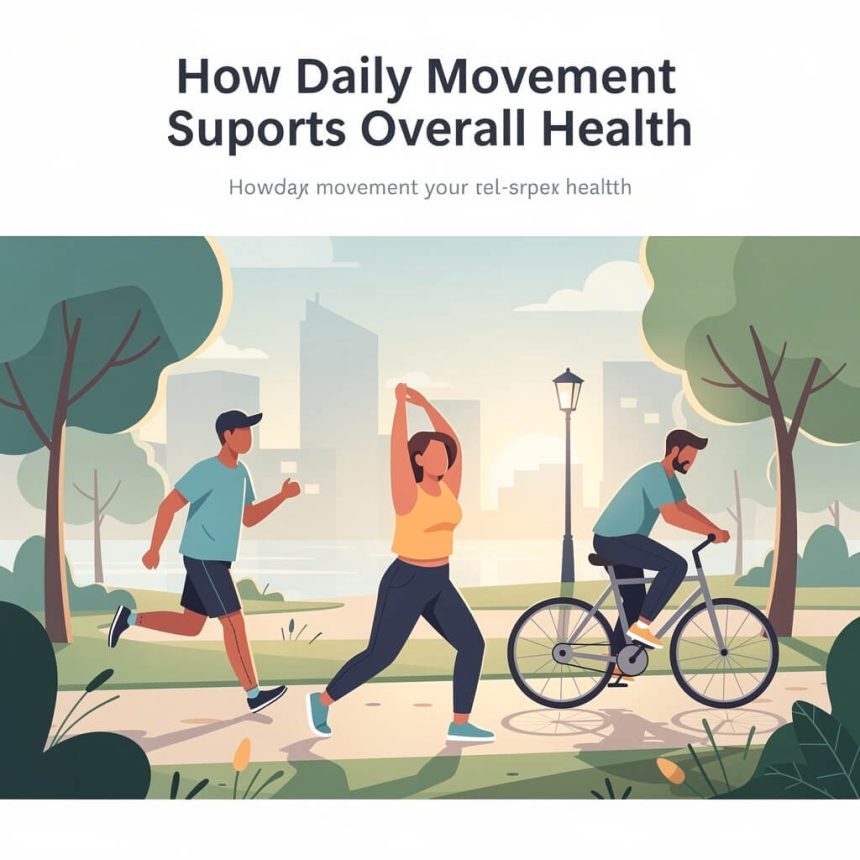
The definition of fitness has undergone a radical transformation over the last few years. In the early 2020s, the focus was often on intense, hour-long gym sessions or grueling marathons. However, as we move through January 2026, the global health community has shifted its gaze toward a more sustainable and impactful concept: consistent daily movement. This shift recognizes that what we do during the 15 or 16 hours we are awake is just as important, if not more so, than the 45 minutes we spend at the gym.
- The Biological Foundation: Why Humans Are Built to Move
- Metabolic Flexibility: The Secret to Sustained Energy
- Longevity and the Vitality Span: Moving to Live Longer
- Brain Health and the Neurochemistry of Motion
- The Risks of the Sedentary Trap
- Trends Shaping Movement in 2026
- Wearable Tech and Biometric Feedback
- The Rise of “Exercise Snacking”
- Longevity Training (Zone 2 Cardio)
- Practical Strategies for a Movement-Rich Life
- 1. The “Movement Sandwich”
- 2. Optimize Your Workspace
- 3. Focus on “Functional” Movement
- 4. Use Social Accountability
- The Role of Sleep and Recovery
- Conclusion: Starting Where You Are
Today, January 5, 2026, millions of people are participating in the Apple Watch “Ring in the New Year” challenge, a testament to how integrated movement has become in our digital lives. Recent data from the Apple Heart and Movement Study shows that users who maintain consistent activity through the first week of January are 90 percent more likely to sustain those habits through the spring. This is not just about burning calories; it is about fundamental biological maintenance.
In this comprehensive guide, we will explore the deep physiological and psychological benefits of daily movement. We will look at the latest research from 2025 and 2026 that links simple activities like walking and standing to enhanced metabolic flexibility, cognitive preservation, and an extended “vitality span.”
The Biological Foundation: Why Humans Are Built to Move
Evolutionarily, the human body is a masterpiece of kinetic engineering. Our ancestors did not “exercise” in the modern sense. They engaged in constant, low-intensity movement punctuated by brief moments of high intensity. Our lymphatic system, unlike our circulatory system, does not have a central pump like the heart. It relies entirely on muscular contraction to move fluid through the body, clearing out cellular waste and supporting immune function.
When we remain sedentary for hours, these systems stagnate. Modern research indicates that the “active couch potato” syndrome, where an individual exercises for an hour but remains seated for the rest of the day, still carries significant health risks. Daily movement acts as the constant “pump” for our biological health.
Metabolic Flexibility: The Secret to Sustained Energy
One of the most exciting areas of health research in 2026 is metabolic flexibility. This refers to your body’s ability to switch efficiently between burning carbohydrates and burning fat for fuel. A study published in the Scandinavian Journal of Medicine and Science in Sports in late 2025 found that reducing sitting time by just 30 to 40 minutes a day significantly improves this metabolic “switch.”
Improving Glucose Management Through Movement
Every time you move your muscles, they require glucose. Daily movement, especially after meals, triggers a process called “non-insulin-mediated glucose uptake.” This means your muscles can pull sugar out of your bloodstream even without a massive spike in insulin.
For those managing or preventing type 2 diabetes, this is a game-changer. Clinical trials in 2025 demonstrated that ten-minute “exercise snacks” or micro-workouts after breakfast, lunch, and dinner were more effective at stabilizing 24-hour blood sugar levels than a single continuous 30-minute walk.
The Role of NEAT in Weight Management
Non-Exercise Activity Thermogenesis (NEAT) accounts for a much larger portion of our daily energy expenditure than intentional exercise. NEAT includes everything from fidgeting and standing to walking to the mailbox or cleaning the house. In 2026, health coaches are prioritizing NEAT because it is the most effective way to prevent the “metabolic adaptation” that often follows strict dieting. By moving consistently, you keep your basal metabolic rate (BMR) elevated throughout the day.
Longevity and the Vitality Span: Moving to Live Longer
We are no longer just obsessed with lifespan (how long you live); we are obsessed with “vitality span” (how long you live well). The latest predictive models from the British Journal of Sports Medicine, updated in late 2024 and early 2025, suggest that individuals over 40 who increase their physical activity to match the top 25 percent of the population could extend their life expectancy by over 5 years. For the most sedentary individuals, adding just 111 minutes of walking daily could result in an 11-year gain in life expectancy.
Why Walking is the Ultimate Longevity Tool
Walking remains the gold standard for daily movement. Research from the American Medical Association highlights that walking between 8,000 and 10,000 steps per day reduces the risk of premature mortality by nearly 40 percent. Even better, the benefits are seen even if these steps are not taken all at once.
Recent “Blue Zones” research, which focuses on populations with the highest number of centenarians, shows that these individuals do not go to gyms. Instead, they live in environments that nudge them into moving every 20 minutes. They garden, they walk to visit neighbors, and they perform manual household tasks. This “natural movement” is the cornerstone of their longevity.
Brain Health and the Neurochemistry of Motion
Perhaps the most profound impact of daily movement is on the brain. When we move, our brains produce a protein called Brain-Derived Neurotrophic Factor (BDNF), often referred to as “miracle-gro for the brain.” BDNF supports the survival of existing neurons and encourages the growth of new ones, particularly in the hippocampus, the area responsible for memory and learning.
Movement as a Natural Antidepressant
The connection between movement and mental health has never been clearer. In 2026, the American College of Sports Medicine (ACSM) listed “Exercise for Mental Health” as a top global trend. Physical activity stimulates the release of endorphins, dopamine, and serotonin. It also helps regulate the body’s stress response by lowering cortisol levels over time.
For those suffering from anxiety, movement provides a “bottom-up” regulation of the nervous system. By engaging the large muscle groups, you signal to the brain that you are taking action, which can break the cycle of “freeze” or “flight” associated with chronic stress.
Cognitive Preservation and Dementia Prevention
Studies published in early 2026 by the World Health Organization (WHO) indicate that meeting global physical activity guidelines (150 to 300 minutes of moderate activity per week) can reduce the risk of dementia and Alzheimer’s disease by up to 28 percent. Walking pace, in particular, has been identified as a “vital sign” for brain health. A faster natural walking speed is often correlated with better cognitive function in older adults.
The Risks of the Sedentary Trap
As technology becomes more immersive, the “sedentary trap” becomes more dangerous. In 2025, researchers identified that sitting for more than eight hours a day without significant movement carries a mortality risk similar to that of smoking or obesity.
Cardiovascular Health and Blood Flow
Prolonged sitting leads to “blood pooling” in the lower extremities and reduced endothelial function (the ability of your blood vessels to dilate). This increases the risk of hypertension, deep vein thrombosis, and varicose veins. Daily movement keeps the vascular system “elastic.” Even standing up for two minutes every hour can restore healthy blood flow and protect the lining of your arteries.
Musculoskeletal Integrity
The “tech neck” and “hunched back” of the digital age are more than just aesthetic concerns. They lead to chronic pain, reduced lung capacity, and nerve compression. Movement is the antidote to “postural rigidity.” Engaging in diverse ranges of motion throughout the day ensures that your fascia (the connective tissue surrounding your muscles) remains hydrated and flexible.
Trends Shaping Movement in 2026
The way we approach daily movement is being revolutionized by technology and new scientific paradigms. Here are the trends defining the landscape in January 2026.
Wearable Tech and Biometric Feedback
Devices like the Apple Watch Series 11 and the Oura Ring Gen 4 have moved beyond simple step counting. They now provide “Training Load” and “Recovery Scores” that tell you exactly when to push and when to move gently. These devices use AI to recognize patterns in your heart rate variability (HRV) and sleep, suggesting “micro-workouts” tailored to your current physiological state.
The Rise of “Exercise Snacking”
In our busy 2026 schedules, the 60-minute workout is being replaced by “exercise snacks.” These are brief bursts of activity (one to five minutes) performed throughout the day. Examples include:
- Three flights of stairs taken quickly.
- One minute of air squats while waiting for coffee.
- A three-minute brisk walk during a phone call.
Research confirms that these “snacks” are highly effective for maintaining cardiovascular fitness and metabolic health.
Longevity Training (Zone 2 Cardio)
There is a growing emphasis on “Zone 2” training, which is low-intensity aerobic exercise where you can still hold a conversation. This intensity is high enough to stimulate mitochondrial growth but low enough to avoid excessive fatigue. In 2026, longevity enthusiasts are prioritizing 150 to 200 minutes of Zone 2 movement weekly to build a “cardiovascular base” that supports all other health goals.
Practical Strategies for a Movement-Rich Life
Transitioning to a movement-first lifestyle does not require a gym membership. It requires a shift in mindset and the environment.
1. The “Movement Sandwich”
Try to “sandwich” your sedentary blocks with movement. If you have an hour-long meeting, walk for five minutes before it starts and five minutes after it ends. This prevents the physiological stagnation that occurs during long periods of sitting.
2. Optimize Your Workspace
If you work from home, use a standing desk or a walking treadmill. If those are not options, place your printer or water bottle in another room, forcing you to get up and walk multiple times a day. In 2026, many forward-thinking companies are implementing “walking meetings” as a standard for one-on-one check-ins.
3. Focus on “Functional” Movement
Incorporate movement into your daily chores. Carry groceries one bag at a time. Park at the far end of the parking lot. Take the stairs instead of the elevator. These small choices accumulate into thousands of extra steps per week.
4. Use Social Accountability
The “Activity Sharing” feature on modern wearables has turned movement into a social game. Joining a “Step Challenge” or a local walking group provides the community support needed to stay consistent, especially during the cold winter months of January.
The Role of Sleep and Recovery
Movement and recovery are two sides of the same coin. You cannot have one without the other. In 2026, we understand that movement actually improves sleep quality by helping to regulate the circadian rhythm. Exposure to natural light during a morning walk signals to the brain that it is time to be alert, which in turn helps the body produce melatonin more effectively at night.
However, it is also important to listen to your body. If your wearable device shows a low recovery score or a high resting heart rate, prioritize “restorative movement” like gentle yoga or stretching rather than high-intensity bursts.
Conclusion: Starting Where You Are
As we look at the health landscape of 2026, it is clear that the most successful people are not those with the most expensive gym memberships, but those who have mastered the art of “continuous motion.” Daily movement is the foundation upon which all other health pillars (nutrition, sleep, and mental wellness) are built.
Whether you are starting with a five-minute walk today or aiming to close your Apple Watch rings for the seventh day in a row, every movement counts. The science is definitive: your body is designed to move, and when you honor that design, your health, energy, and longevity will flourish.