


Laser printed hydrogel implant could transform bone repair
- Date:
- March 3, 2026
- Source:
- ETH Zurich
- Summary:
- When a bone break is too severe to heal on its own, surgeons often rely on grafts or rigid metal implants â but both come with serious drawbacks. Now, researchers at ETH Zurich have created a jelly-like hydrogel that mimics the bodyâs natural healing process, offering a potentially game-changing alternative. Made of 97% water, this soft material can be laser-printed into intricate bone-like structures at record-breaking speeds, down to details thinner than a human hair.
- Share:
Bones fractured in a (skiing) accident often mend without medical intervention. However, when a break is especially severe or a bone tumor must be surgically removed, doctors rely on implants to stabilize the area and support new bone growth.
Today’s implants are commonly made from the patient’s own bone, called autografts, or from metal and ceramic materials. Autografts require an additional operation to collect the bone tissue, which increases recovery time and surgical risk. Metal implants can also create problems because they are much stiffer than natural bone and may loosen over time, reducing long term stability.
Designing Bone Implants That Work With Biology
Bone is far more intricate than it appears. It contains countless microscopic tunnels and hollow spaces that are essential for strength and function. “For proper healing, it is vital that biology is incorporated into the repair process,” says Xiao-Hua Qin, Professor of Biomaterials Engineering at ETH Zurich. Successful bone repair depends on multiple types of cells moving into the implant first, then working together to build new tissue.
To better match this biological complexity, Qin and his team, together with ETH Professor Ralph Müller, developed a new type of hydrogel designed for future bone implants. The soft material, similar in texture to jelly, gradually dissolves inside the body and may eventually allow for customized implants tailored to individual patients. Their findings were recently published in Advanced Materials.
Inspired by the Body’s Natural Healing Process
When a bone first breaks, the body does not immediately create hard tissue. Instead, it forms a soft, permeable structure. In the early days after injury, a hematoma or bruise develops at the fracture site. This temporary scaffold allows immune and repair cells to move in while delivering nutrients. A network of fibrin holds these cells together. Over time, this flexible framework slowly transforms into solid bone.
The newly developed hydrogel is designed to imitate this early healing phase. It consists of 97 percent water and 3 percent biocompatible polymer. To control when and where it hardens, the researchers added two specialized molecules. One connects the polymer chains, while the other reacts when exposed to light, triggering the solidification process.
Wanwan Qiu, a former doctoral student of Qin and Müller, created the linking molecule specifically for this purpose. “It enables rapid structuring of hydrogels in the sub-micrometer range,” she says. When laser pulses of a specific wavelength strike the material, the polymer chains immediately bond and form a solid structure. Areas not exposed to the laser remain soft and can later be removed.
Record Breaking Laser Printing at the Nanoscale
Using this technique, the team can precisely shape the hydrogel with exceptional detail. The laser can create structures as small as 500 nanometres.
“Hydrogels resemble jelly, making them difficult to shape,” says ETH Professor Qin. “With our newly developed connecting molecule, we can now not only structure the hydrogel in a stable and extremely fine manner but also produce it at high writing speeds of up to 400 millimeters per second. That’s a new world record.”
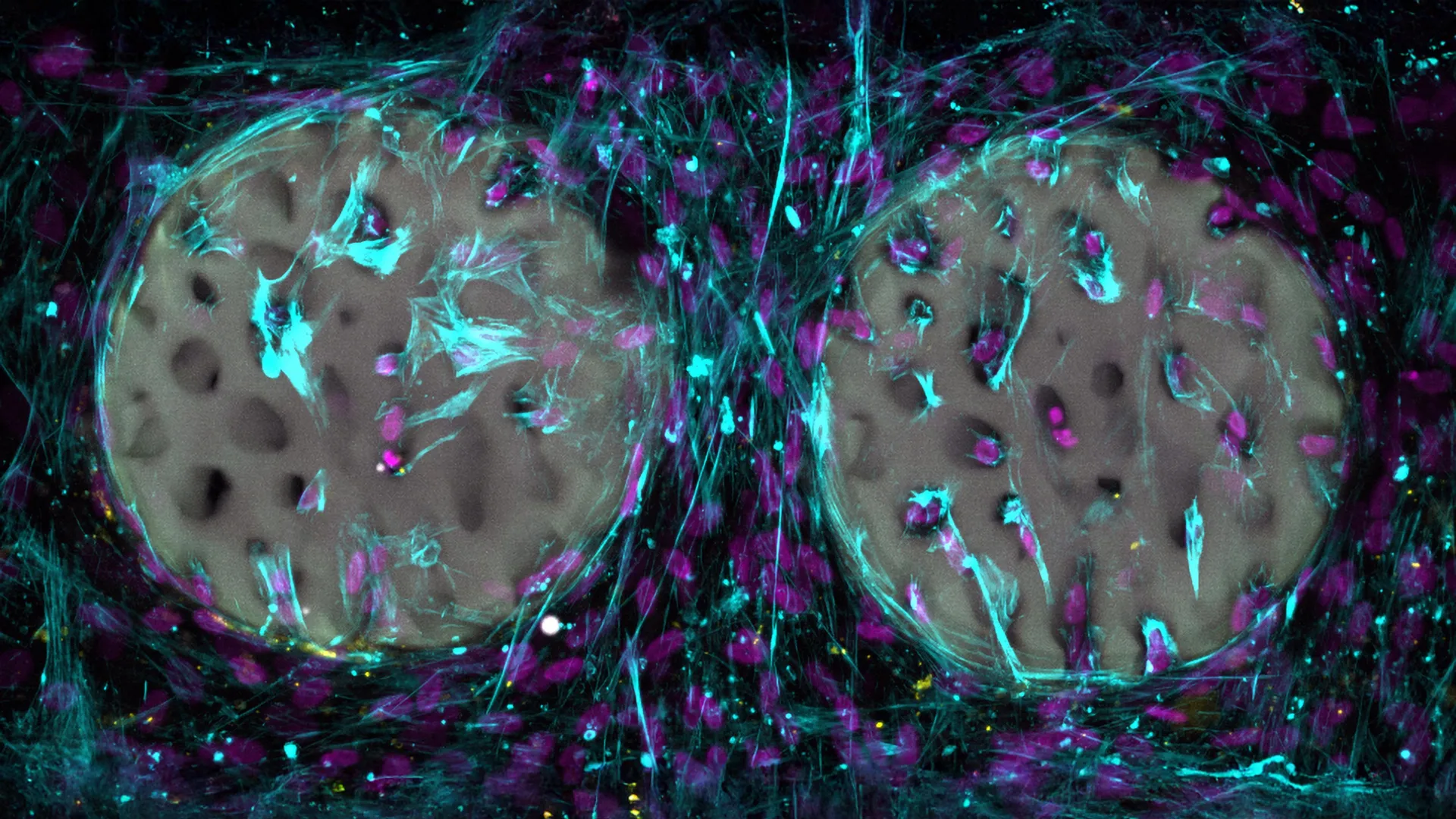
In their experiments, the researchers produced highly detailed hydrogel structures modeled on real bone. Using medical imaging as a guide, they recreated the delicate lattice known as trabeculae that gives bone its internal strength.
Natural bone itself contains an astonishing network of fluid filled channels that are only nanometres wide. “A piece of bone the size of a dice contains 74 kilometers of tunnels,” says Qin. For comparison, the Gotthard Base Tunnel, the world’s longest railway tunnel, stretches 54 kilometers.
Early Lab Tests Show Promising Results
So far, the material has been evaluated only in laboratory experiments. In test tube studies, bone forming cells quickly moved into the structured hydrogel and began producing collagen, a key building block of bone. The researchers also confirmed that the material is biocompatible and does not harm these cells. The base material has been patented, and the team intends to make it available to medical manufacturers.
The ultimate aim is to bring hydrogel based implants into clinical use for repairing broken bones. Additional research is still required. Qin is preparing animal studies in partnership with the AO Research Institute Davos. These tests will examine whether the material supports the movement of bone forming cells inside living organisms and whether it can restore bone strength over time.
Story Source:
Materials provided by ETH Zurich. Note: Content may be edited for style and length.
Journal Reference:
- Wanwan Qiu, Margherita Bernero, Muja Emilie Ye, Xianjun Yang, Philipp Fisch, Ralph Müller, XiaoâHua Qin. A WaterâSoluble PVA Macrothiol Enables TwoâPhoton Microfabrication of CellâInteractive Hydrogel Structures at 400 mm sâ1. Advanced Materials, 2026; DOI: 10.1002/adma.202510834
Cite This Page:
📰 This article was curated and published by
HEALTH GUIDANCE HUB
— your trusted source for the latest health news, medical research, and wellness guidance.
Visit us at https://healthguidancehub.space/ for more health insights.
