

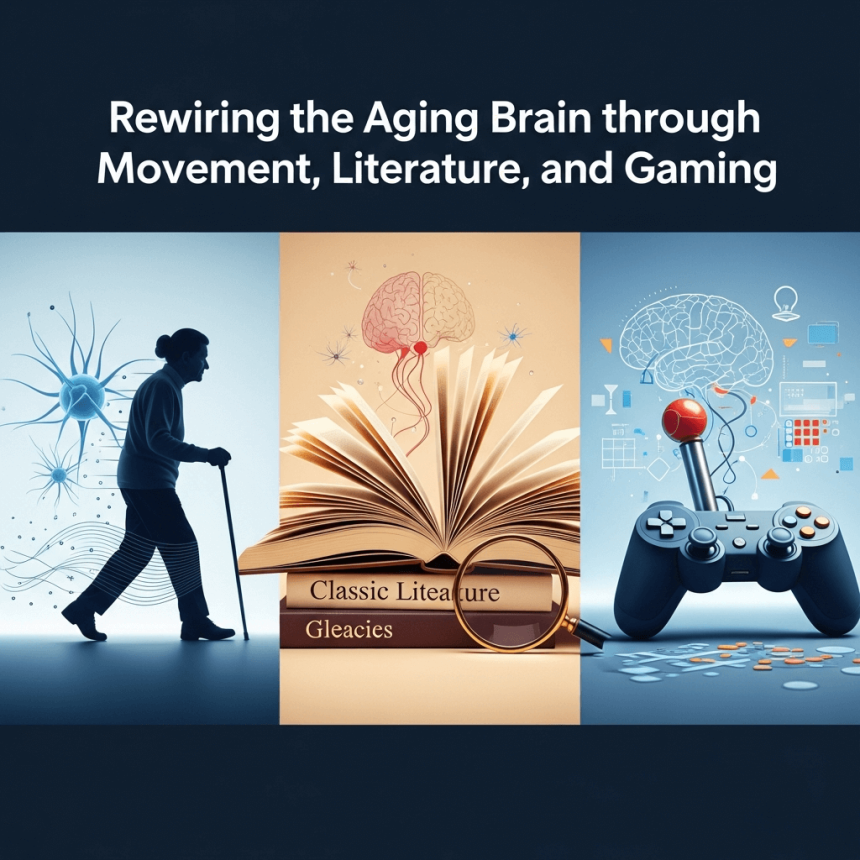
In the landscape of modern wellness, the year 2026 has marked a pivotal shift in how we approach the concept of getting older. We have moved beyond the simple pursuit of a long life and have entered the era of the healthspan, where the quality of our cognitive function is considered the ultimate currency. Recent breakthroughs in neuroscience have illuminated a fascinating truth: the brain is not a static organ destined for inevitable decline. Instead, it is a dynamic, plastic system that can be actively “rewired” through specific, engaging lifestyle choices.
- The Science of Brain Clocks and Neuroplasticity
- Dancing: The Rhythmic Medicine for the Mind
- Deep Reading: Safeguarding White Matter Integrity
- Video Games: The New Frontier of Digital Therapeutics
- The Midlife Critical Window: Why Now Matters
- Crafting Your 2026 Neuro-Protocol
- Monday: The Literary Reset
- Wednesday: The Gaming Challenge
- Friday: The Rhythmic Movement
- Daily: Metabolic Support
- The Future of Aging: A Proactive Approach
Among the most exciting findings published this week in January 2026, researchers have pinpointed three activities that offer profound protection against cognitive decay: dancing, deep reading, and strategic video gaming. This triumvirate of brain-boosting habits does more than just provide entertainment; they act as powerful digital and physical therapeutics that can literally shrink your biological brain age.
The Science of Brain Clocks and Neuroplasticity
To understand why these activities work, we must first look at the latest developments in neuroimaging. Scientists at SWPS University and Trinity College Dublin recently utilized advanced algorithms known as “brain clocks” to measure the biological age of the human brain. By analyzing EEG and MEG recordings from over 1,400 participants globally, they discovered that people who regularly engage in creative and cognitively demanding activities possess a “brain age gap” where their neurological profiles appear years younger than their chronological age.
This phenomenon is rooted in neuroplasticity, the brain’s ability to form new neural connections and reorganize existing ones in response to learning and experience. While we once believed that neuroplasticity peaked in childhood, we now know that the adult brain remains highly adaptable, provided it is given the right stimuli. The key is “synaptic density” and “white matter integrity,” both of which are significantly enhanced by the three pillars of cognitive longevity.
Dancing: The Rhythmic Medicine for the Mind
Dancing is often categorized as a physical exercise, but from a neurological perspective, it is one of the most complex tasks a human can perform. It requires the simultaneous integration of multiple brain systems: the motor cortex for movement, the cerebellum for balance, the sensory cortex for music processing, and the prefrontal cortex for social interaction and sequence memorization.
The Tango Effect and Spatial Memory
Recent studies highlighting the benefits of the Tango have shown that the intricate footwork and the need to anticipate a partner’s movements provide a unique form of “motor-cognitive training.” This specific type of stimulation has been linked to a 76% reduction in the risk of dementia, a figure that outperforms almost any other physical activity.
In 2026, many longevity clinics are now prescribing “social dance therapy” as a primary intervention for early-stage cognitive decline. The reason is simple: dancing stimulates the production of nerve growth factors. These proteins are essential for the health of sensory neurons and the creation of new synapses in the hippocampus, the region of the brain responsible for spatial memory and navigation.
Neurorehabilitation and Parkinson’s Disease
The impact of dance extends into clinical neurorehabilitation. For individuals facing Parkinson’s disease or other movement disorders, dance acts as a non-pharmacological intervention that improves gait stability and executive function. By focusing on rhythm and emotional expression, patients can bypass damaged neural pathways and utilize healthier regions of the brain to maintain mobility.
Deep Reading: Safeguarding White Matter Integrity
In an age of rapid-fire digital consumption, the act of “deep reading” has become a radical tool for brain health. While scrolling through social media feeds provides quick hits of dopamine, it does little to strengthen the brain’s architecture. Conversely, immersive reading of long-form literature or complex non-fiction creates measurable changes in the brain’s white matter.
The Connectivity Advantage
White matter acts as the “cabling” of the brain, facilitating communication between different regions. A systematic review published in late 2025 demonstrated that consistent reading habits optimize the structural integrity of these pathways. This leads to faster processing speeds and better inter-regional communication, which are often the first things to decline as we age.
Furthermore, reading fosters what psychologists call “cognitive empathy.” By navigating the complex emotional landscapes of fictional characters or following the rigorous logic of a philosophical treatise, readers are essentially “weightlifting” with their prefrontal cortex. This keeps the brain flexible and resilient against the “metabolic stress” that often precedes Alzheimer’s disease.
The Literary Trends of 2026
Interestingly, the “2026 State of Reading Report” indicates a massive resurgence in physical book sales and dedicated “digital-free” reading hours. High-performers and “bio-hackers” are increasingly adopting reading streaks, with many aiming for 30-day challenges to reset their attention spans and fortify their mental clarity. This trend is not just about nostalgia; it is a calculated move to protect the brain’s “executive suite” from the fragmentation of the digital world.
Video Games: The New Frontier of Digital Therapeutics
Perhaps the most controversial, yet scientifically backed, tool for brain health is the use of strategic video games. For decades, gaming was viewed as a sedentary distraction. However, in 2026, the medical community has embraced “Digital Therapeutics” (DTx) as a legitimate way to combat brain aging.
Action Games vs. Strategy Games
Not all games are created equal. Research from the University of Montreal and UCSF’s Neuroscape Center has shown that 3D platformers and complex strategy games provide the most significant benefits. For example, playing games like “Super Mario 64” has been shown to increase grey matter in the hippocampus of seniors aged 55 to 75.
3D environments require the brain to create mental maps, a process that directly challenges the parts of the brain most vulnerable to neurodegeneration. On the other hand, fast-paced action games improve “attentional blink” and reaction times, effectively reversing the “slowing” of the brain that typically occurs after age 50.
Virtual Reality and Labyrinth Training
The cutting edge of this field involves Virtual Reality (VR). The “Labyrinth” VR intervention, developed by researchers at UC San Francisco, requires users to navigate complex virtual neighborhoods while completing various errands. This “dual-task” environment, combining physical movement (via a stationary bike or treadmill) with cognitive problem-solving, has shown the ability to improve “high-fidelity memory” in older adults, with the benefits lasting for years after the training ends.
The Midlife Critical Window: Why Now Matters
One of the most profound discoveries of 2025 and 2026 is the “midlife critical window.” Neuroimaging data suggests that brain aging follows a non-linear path, with a significant transition occurring between the ages of 40 and 60. During this period, the brain becomes more vulnerable to insulin resistance and metabolic desynchronization.
This is the “golden hour” for intervention. By incorporating dancing, reading, and gaming into one’s routine during these two decades, individuals can effectively “stabilize” their neural networks before the regulatory mechanisms “break.” Waiting until 70 or 80 to start these habits is still beneficial, but the protective power is exponentially higher when started in middle age.
Crafting Your 2026 Neuro-Protocol
To maximize the benefits of these findings, one should consider a holistic approach that combines these activities into a weekly “Neuro-Protocol.”
Monday: The Literary Reset
Start the week with 60 minutes of deep reading. Focus on a single book, avoiding the temptation to check your smartphone. This sets a tone of focused attention for the rest of the week and strengthens the white matter pathways.
Wednesday: The Gaming Challenge
Engage in 45 minutes of a 3D strategy or navigation game. If you are new to gaming, start with accessible titles that emphasize exploration. The goal is to challenge your spatial memory and force your brain to build new mental maps.
Friday: The Rhythmic Movement
Join a social dance class, such as Tango, Salsa, or Swing. The combination of physical exertion, social connection, and rhythmic synchronization provides a “perfect storm” of neuroplastic stimulation.
Daily: Metabolic Support
In addition to these activities, the latest research suggests supporting your brain with “ketones” and “creatine for the brain.” As we enter midlife, our neurons may struggle to process glucose efficiently. Providing alternative fuel sources like exogenous ketones can help “restabilize” brain networks and provide the energy needed for the intensive learning involved in dancing and gaming.
The Future of Aging: A Proactive Approach
As we look forward into the remainder of 2026, it is clear that the “old way” of thinking about aging—as a period of decline to be managed with medication—is being replaced by a proactive, lifestyle-first philosophy. We are seeing the rise of “Longevity Clinics” that specialize in personalized brain-health assessments, using the very “brain clocks” mentioned earlier to tailor interventions for each individual.
The evidence is undeniable: your brain is a “use it or lose it” organ. By embracing the joy of dance, the depth of literature, and the challenge of digital worlds, you are doing more than just passing the time. You are building a cognitive reserve that will serve you for decades to come. The “youthful” brain of the future is not found in a pill, but in the rhythm of our feet, the pages of our books, and the pixels on our screens.