

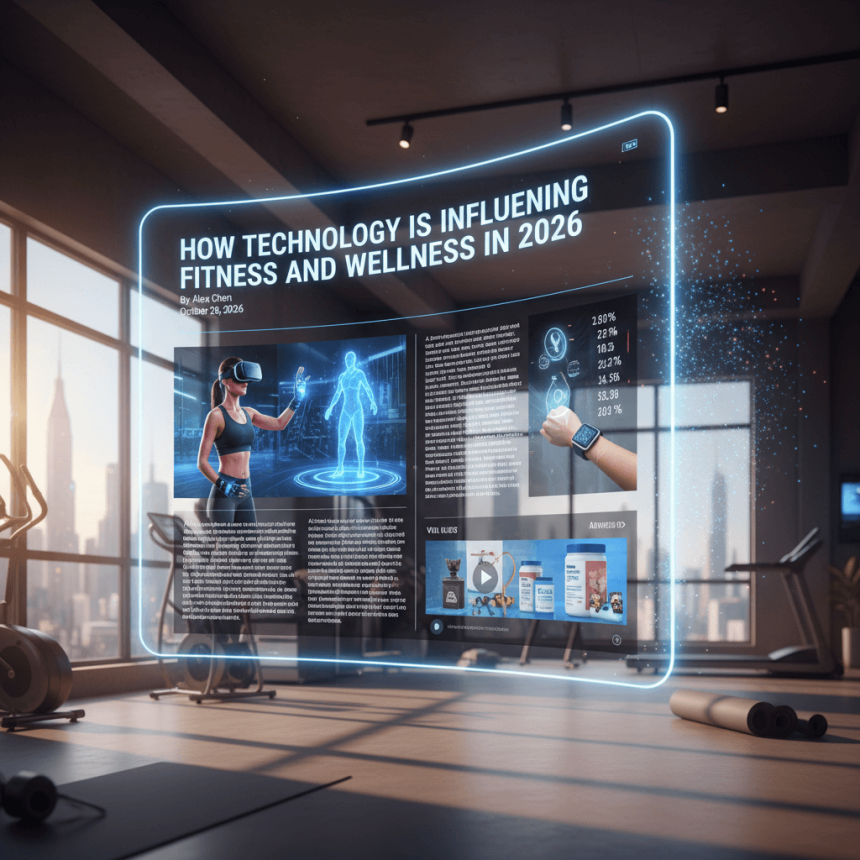
The landscape of physical health and mental well-being has undergone a radical transformation as we step into January 2026. The days of generic workout routines and manual calorie counting are now relics of a bygone era. Today, the convergence of artificial intelligence, high-precision medical wearables, and immersive spatial computing has created an ecosystem where wellness is not just a goal but a continuous, automated state of being.
- The Rise of the AI Health Copilot: Hyper-Personalization at Scale
- Wearable Technology 3.0: The Diagnostic Powerhouse on Your Wrist
- Immersive Wellness: Spatial Fitness and the Metaverse
- Neuro-Fitness: Training the Brain to Optimize the Body
- The Evolution of the Smart Home Gym: Robotics and AI Strength
- Corporate Wellness: The Enterprise Fitness Revolution
- Longevity and Biohacking: Reversing the Biological Clock
- The Role of Big Data and Healthcare Integration
- Conclusion: The New Era of Human Potential
In this deep dive, we explore the most significant technological shifts influencing how we move, eat, and recover in 2026. From the rise of the AI health copilot to the mainstream adoption of longevity-focused biohacking, this is how the digital and physical worlds have finally merged to optimize the human machine.
The Rise of the AI Health Copilot: Hyper-Personalization at Scale
The most significant shift in 2026 is the move from “reactive” fitness to “predictive” wellness. This is driven primarily by advanced AI health copilots that live within our devices. Unlike the basic apps of five years ago, today’s AI agents utilize large-scale multimodal models to understand your body better than you do.
Real Time Adaptive Programming
In 2026, a workout is no longer a static list of exercises. Instead, your AI coach monitors your biometrics in real time and adjusts your session as you perform it. If your heart rate variability (HRV) suggests you didn’t recover well from last night’s sleep, your coach will automatically pivot your planned high-intensity interval training (HIIT) session to a restorative mobility flow.
This level of precision ensures that individuals are always training within their “optimal zone,” maximizing results while virtually eliminating the risk of overtraining or injury. Companies like Zing Coach and Freeletics have pioneered this space, integrating with various sensors to provide a seamless feedback loop that evolves daily.
Metabolic Health and Continuous Monitoring
One of the breakthrough trends this year is the widespread adoption of non-invasive continuous metabolic monitoring. Technologies that were once reserved for clinical settings or elite athletes are now available to the general public. Smart patches and advanced optical sensors can now track blood glucose levels, hydration, and even lactate thresholds without a single needle prick.
By understanding how specific foods affect your blood sugar in real time, you can tailor your nutrition with surgical precision. This is not just about weight loss. It is about sustained energy levels, cognitive clarity, and the prevention of metabolic diseases before they even begin to manifest.
Wearable Technology 3.0: The Diagnostic Powerhouse on Your Wrist
As of January 5, 2026, the wearable market has reached a point of clinical maturity. We are no longer just counting steps. We are conducting a full body diagnostic every second of every day.
The New Titans: Apple Watch Ultra 3 and Oura Ring Gen 4
The recent launches of the Apple Watch Ultra 3 and the Oura Ring Gen 4 have set a new standard for what consumers expect from their hardware. The Ultra 3 now features medical-grade blood pressure monitoring and advanced hydration tracking, making it an essential tool for endurance athletes and those managing cardiovascular health.
Meanwhile, the Oura Ring Gen 4 has mastered the art of “invisible technology.” It provides deep insights into hormonal health, sleep architecture, and stress resilience, all while maintaining a form factor that looks like a piece of high-end jewelry. The integration of these devices with healthcare providers means that your doctor can receive a weekly summary of your vitals, allowing for truly personalized medical care.
Smart Clothing and Bio-Sensing Fabrics
Beyond the wrist and the finger, 2026 has seen the rise of bio-sensing fabrics. Smart compression gear and athletic wear now contain embedded sensors that track muscle activation (EMG), gait symmetry, and even sweat composition. For runners and weightlifters, this means receiving instant haptic feedback on their form. If your left glute is not firing during a squat, or if your running stride becomes imbalanced, your clothing will gently vibrate to guide you back into alignment.
Immersive Wellness: Spatial Fitness and the Metaverse
The concept of “going to the gym” has been redefined by spatial computing. With the release of more lightweight and powerful mixed reality (MR) headsets, fitness has become an immersive experience that bridges the gap between gaming and physical exertion.
Spatial Workouts and Gamification
Platforms like Supernatural and FitXR have evolved into full-fledged “spatial fitness” ecosystems. In 2026, you can transform your living room into a volcanic landscape or a serene Martian base. The gamification of fitness has solved the “motivation gap” for millions. When you are dodging obstacles and striking targets to the beat of your favorite music in a stunning 360-degree environment, the “work” in workout disappears.
Virtual Coaching and Social Presence
Technology has also solved the loneliness of at-home fitness. Through high-fidelity avatars and spatial audio, you can now join a group class where you feel the presence of other participants and the instructor as if they were in the room with you. This social layer is a powerful driver of consistency. Research in early 2026 indicates that users who participate in virtual group fitness are 60% more likely to stick to their routines compared to those training solo.
Neuro-Fitness: Training the Brain to Optimize the Body
In 2026, the fitness industry has recognized that the brain is the ultimate governor of physical performance. Neuro-fitness has emerged as a major pillar of wellness, focusing on cognitive-motor training.
Brain-Computer Interfaces (BCI) for Meditation
Meditation and mindfulness have been supercharged by brain-computer interfaces. Sleek headbands now provide real-time neurofeedback during meditation sessions. If your mind begins to wander, the app might change the sound of the rain in your headphones to a storm, gently nudging you back into a state of focus. This “closed-loop” system allows users to master mental discipline in a fraction of the time it used to take.
Cognitive Enhancement Through Movement
Elite training centers are now using “Dual-Tasking” technology, where athletes must solve complex spatial puzzles on a screen while performing high-intensity movements. This strengthens the neural pathways between the prefrontal cortex and the motor cortex, improving reaction times and decision-making under pressure. This technology is also being repurposed for “active aging” programs to help older adults maintain cognitive health and prevent neurodegenerative diseases.
The Evolution of the Smart Home Gym: Robotics and AI Strength
The home gym of 2026 looks nothing like the bulky iron racks of the past. It is sleek, connected, and powered by robotics.
Robot-Assisted Resistance
Systems like the latest Tonal and Amp units use electromagnetic resistance and robotic arms to provide a workout that iron weights cannot match. In 2026, these machines can automatically perform “spotting” duties. If the machine senses your velocity slowing down, it will subtly reduce the weight to help you finish the rep safely. Conversely, it can add “eccentric loading,” making the weight heavier on the way down to maximize muscle hypertrophy.
Smart Mirrors and Computer Vision
AI-powered mirrors are now standard in high-end home gyms. Using advanced computer vision, these devices track your skeleton in 3D space, providing frame-by-frame form correction. They can detect if your knees are caving in during a lunge or if your back is rounding during a deadlift. This real-time feedback provides the safety of a personal trainer with the convenience of a 24/7 home setup.
Corporate Wellness: The Enterprise Fitness Revolution
One of the highest-growth sectors in 2026 is corporate wellness technology. Companies have realized that a healthy workforce is a more productive and profitable one.
Integrated Health Platforms for Employees
Large enterprises are now providing employees with comprehensive “Well-Tech” packages. This often includes high-end wearables, access to AI-driven nutrition platforms, and virtual reality stress-relief zones. These platforms are often integrated with health insurance providers, where employees can earn lower premiums by hitting certain wellness milestones. This data-driven approach to corporate health is transforming the workplace from a source of stress into a hub for longevity.
The Rise of the Chief Wellness Officer
In 2026, the “Chief Wellness Officer” has become a staple position in the C-suite. Their role is to leverage technology to monitor organizational burnout levels, optimize office ergonomics with AI, and implement data-backed wellness initiatives that improve both mental and physical health across the company.
[Image showing a modern corporate wellness center with employees using VR headsets for stress relief and smart desks for ergonomic optimization]
Longevity and Biohacking: Reversing the Biological Clock
The ultimate goal of fitness technology in 2026 is no longer just “looking good” or “feeling fit.” It is about longevity. Biohacking has moved from the fringes of Silicon Valley into the mainstream.
Personalized Genomic Nutrition
In 2026, nutrition is based on your unique genetic blueprint. Simple at-home DNA and microbiome testing kits provide a detailed roadmap of how your body processes different macronutrients and vitamins. AI then takes this data and crafts a daily meal plan that optimizes your gut health and longevity markers. Services now exist that can deliver pre-prepared meals to your door, perfectly balanced to your specific biological needs on that exact day.
High-Tech Longevity Protocols
Technology like Red Light Therapy (photobiomodulation), Cryotherapy, and Hyperbaric Oxygen Chambers are now increasingly common in home settings. Smart versions of these devices sync with your wearable data. For example, if your Oura ring detects high systemic inflammation after a marathon, your home cryo-chamber will pre-heat (or pre-cool) to the exact settings recommended for your recovery.
The Role of Big Data and Healthcare Integration
Perhaps the most impactful change in 2026 is how fitness data is finally talking to the medical system.
Precision Medical Diagnostics
The barrier between “wellness data” and “medical data” has collapsed. Your wearable’s ECG and blood oxygen readings are now accepted by most major healthcare providers as valid diagnostic data. This allows for early detection of conditions like atrial fibrillation or sleep apnea without the need for an expensive and inconvenient overnight hospital stay.
The Democratization of Health Information
High-speed 6G connectivity and edge computing mean that even people in remote areas can access top-tier fitness and medical guidance. AI-driven diagnostic tools can provide preliminary health assessments via a smartphone camera and a few sensors, democratizing access to wellness expertise that was once the exclusive domain of the wealthy.
Conclusion: The New Era of Human Potential
As we look at the state of technology in 2026, it is clear that we have entered a new era. Technology is no longer a distraction from our health. It is the primary tool for its optimization. By leveraging AI, wearables, and immersive environments, we are moving toward a future where “getting fit” is easier, safer, and more personalized than ever before.
The human body has not changed in thousands of years, but our ability to understand, track, and improve it has reached a pinnacle. Whether you are an elite athlete looking for that 1% edge or someone simply trying to live a long and healthy life, the technology of 2026 is here to ensure you reach your full potential.